Built for what’s next: Trulaske gives students a launchpad for modern business
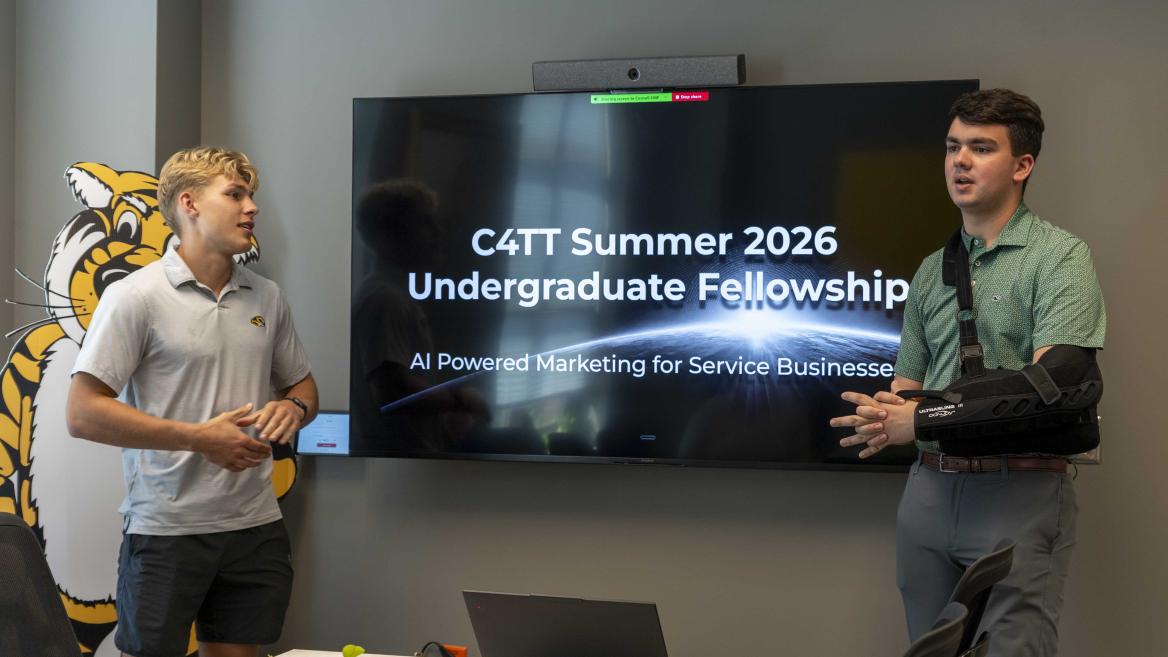
Finance students Tim Sebolt and Bryce Rudolph are only in their second year at the University of Missouri, but they’re already confronting the kinds of questions that will define the next generation of business.
How can artificial intelligence solve a real problem? How do you turn emerging technology into something a customer will actually pay for? And what happens when your first idea doesn’t work?
At the Robert J. Trulaske, Sr. College of Business, they aren’t waiting until graduation to find out.
Through a fellowship with the college’s Center for Transformative Technology (C4TT), Sebolt and Rudolph spent the summer exploring how artificial intelligence could improve marketing for service businesses. C4TT provided funding for technology and software, access to mentors and opportunities to learn from others working with emerging technology.
What began as an opportunity to experiment became something more: Boltara Scaling, a business that helps companies use AI-powered marketing to generate new customers and revenue.
For Trulaske, their experience illustrates what preparing students for modern business increasingly looks like.
“C4TT really gave us a good space to think of ideas of what we even wanted to explore,” Sebolt said. “They also gave us funding that allowed us to explore these ideas.”
Learning by doing
Transformative Technology is one of three strategic pillars guiding the Trulaske College of Business, alongside Experience-Centered Learning and Entrepreneurial Mindset.
For Sebolt and Rudolph, all three converged during their fellowship.
The students had already become interested in generative AI, but they wanted to go beyond using it for familiar tasks such as writing, research or presentations. They approached C4TT with an idea: explore how the rapidly expanding collection of AI tools could be applied to marketing.
With support from C4TT Director Drew Reeves and the center’s team, they began experimenting.
Their fellowship funding paid for software licenses that allowed them to work with sophisticated AI, automation, customer relationship management and content-creation tools. More importantly, the fellowship gave them the opportunity to figure out how those technologies could work together to solve an actual business problem.
“Exposure is where it starts, not the destination,” Reeves said. “Tim and Bryce worked with our C4TT team, got hands-on with AI tools, and then applied a practitioner’s lens: what could this do for a problem they already understood? They took that and built something that creates real value for businesses.”
The students focused on service businesses, where they saw an opportunity to help companies develop more consistent ways of finding customers.
They began working with real clients and testing their ideas in the marketplace. The technology helped them create and manage advertising, follow up with potential customers, analyze results and automate parts of the process.
But the most important lessons weren't necessarily technological.
Sebolt had to learn how to sell to businesses. The pair had to listen to customers and refine what they were offering. Some ideas worked. Others didn’t.
“There were a lot of things we tried for campaigns for clients that ultimately didn’t work,” Sebolt said. “So we had to make a lot of tweaks to get much better results.”
That experience changed the business itself.
“What we originally started with is nothing like where we are now,” he said.
It is exactly the kind of iterative learning Trulaske is increasingly creating opportunities for students to experience: Start with knowledge, put it into practice and learn from what happens next.
Technology — with judgment
Neither Sebolt nor Rudolph chose Mizzou because of artificial intelligence.
The technology was evolving so rapidly that it was barely part of their thinking when they began considering colleges.
Sebolt, a fourth-generation Mizzou student, said attending the university felt almost inevitable. His grandfather attended the business school, and some of his earliest memories involve Mizzou athletics.
Rudolph also grew up in a Mizzou family. His mother attended the university, and he remembers coming to games as a child.
Once they arrived at Trulaske, however, emerging technology quickly became part of their education.
Sebolt remembers Reeves and other C4TT staff visiting his freshman interest group and demonstrating AI tools students could use to study, research and create presentations.
It changed how he thought about the technology.
“Once your brain starts to really work with it, over time, it’s kind of a skill you develop,” he said.
That skill is already proving useful beyond campus. During another internship this summer, Sebolt found himself identifying ways his employer could incorporate AI into existing processes. Ideas that seemed increasingly routine to him were new to colleagues who had spent much longer in the workforce.
For Sebolt, the experience underscored an opportunity for students entering business now.
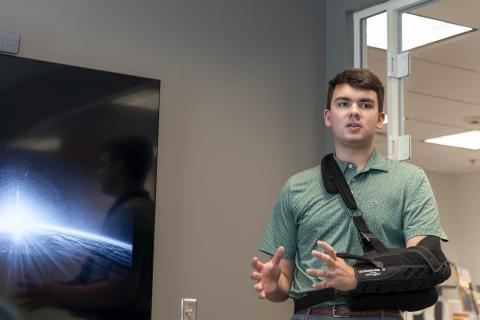
Rudolph sees another important lesson: Knowing how to use AI is not the same as knowing when to trust it.
He worries about people using the technology as “a handicap” rather than a tool to extend their own abilities. AI can make mistakes, which means the person using it still needs the knowledge and judgment to evaluate the result.
That distinction is central to what Trulaske wants students to understand about transformative technology.
Balaji Rajagopalan, dean of the Robert J. Trulaske, Sr. College of Business, said experiences like these are essential to preparing students for a rapidly changing business world.
“The business world our students are entering is changing at an extraordinary pace,” Rajagopalan said. “Our responsibility is not simply to teach them how to use today’s technology, because those tools will continue to change. We must give students opportunities to develop the judgment, adaptability and entrepreneurial mindset to understand new technologies and put them to work responsibly. Experiences like this prepare students not just for their first job, but to continue leading as business evolves.”
A launchpad for opportunity
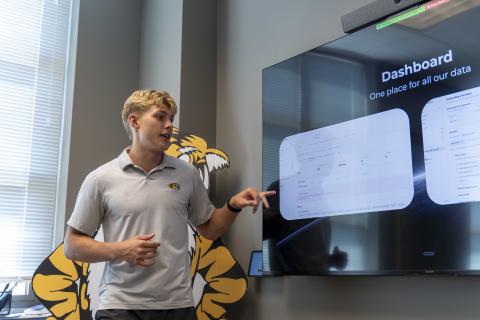
The fellowship has ended, but Sebolt and Rudolph are continuing to build Boltara.
They also were selected among the top 10 from a pool of 55 applicants for Mizzou’s Entrepreneur Quest student accelerator. The eight-week incubator culminates Nov. 17 in a final pitch competition featuring a $30,000 prize pool.
Meanwhile, C4TT continues to give them opportunities to present their work, connect with faculty and participate in the larger conversation about transformative technology.
For Rudolph, that ecosystem is part of what makes his Trulaske education valuable. The college is giving students opportunities to learn about AI while also creating experiences in which they can apply what they know.
Sebolt describes Trulaske as a launchpad.
When he has questions about business, classes or an idea he wants to pursue, he said faculty and staff want to help.
“I’ve been given an opportunity, and I’m going to go chase it,” he said.
That willingness to chase an opportunity may matter as much as any particular technology the students mastered this summer.
The tools they are using today will change. New AI platforms will emerge. Existing ones will disappear. Businesses will encounter problems that haven't yet been imagined.
Preparing students for that world requires more than teaching them which buttons to push.
It requires giving them opportunities to encounter something unfamiliar, learn it, apply it, discover where it falls short and figure out what to do next.
That is what Sebolt and Rudolph experienced through C4TT.
And it is why the story of Boltara is about more than two students starting a business.
It is an example of what can happen when Transformative Technology, Experience-Centered Learning and Entrepreneurial Mindset stop being separate ideas and become a single student experience.
Sebolt has his own definition for that.
Being a Changemaker, he said, means “taking initiative to solve a problem that you see in the world.”
At Trulaske, students like Sebolt and Rudolph are getting the opportunity to start doing exactly that — long before they graduate.
About Entrepreneur Quest
Mizzou's Entrepreneur Quest is an eight-week student accelerator program designed to help aspiring entrepreneurs turn innovative ideas into viable businesses. Through mentorship, business development and hands-on learning, participants refine their concepts, strengthen their business models and prepare to pitch their ventures.
This year, 10 finalists were selected from 55 applicants. The program culminates Nov. 17 with a final pitch competition featuring a $30,000 prize pool.