When AI has the answers, who's accountable? EY leader explores ethics and the future of accounting at Mizzou
Artificial intelligence can analyze financial data, prepare reports and identify potential problems in seconds. But when the technology makes a mistake, who is responsible?
That question was at the heart of the 2026 Richard M. Orin Ethics Symposium, held Nov. 6 at the University of Missouri's Robert J. Trulaske, Sr. College of Business.
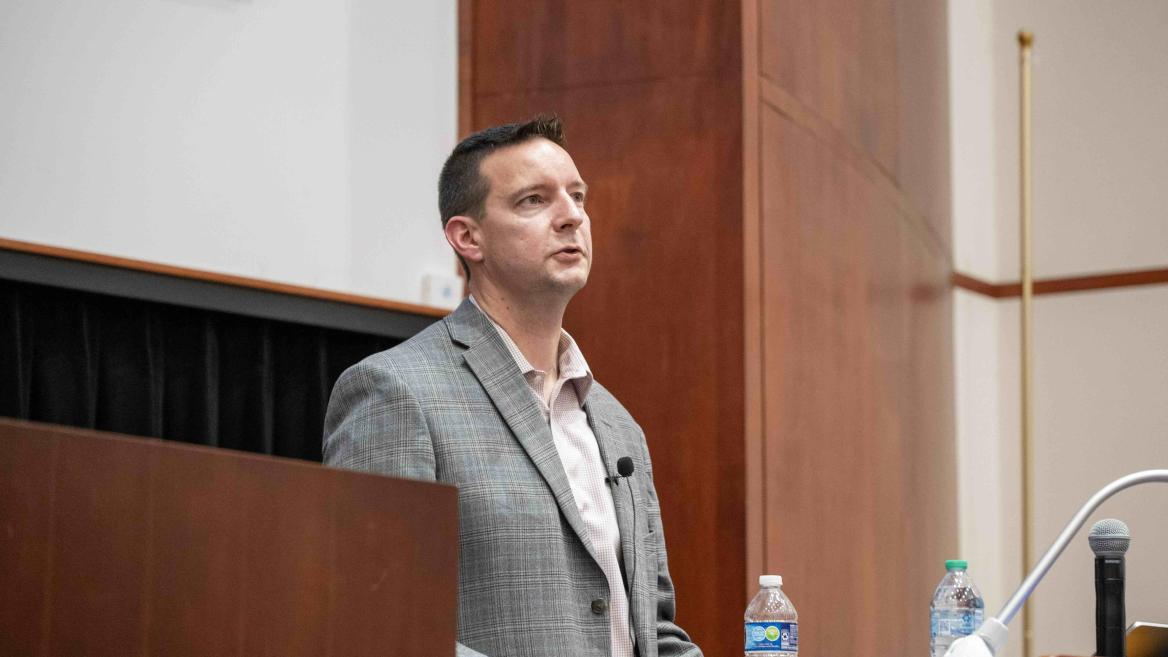
Rick Clark, an assurance partner and Assurance AI champion at EY, challenged students, faculty and business professionals to consider how emerging technology is reshaping accounting — and why human judgment matters more than ever.
"When a machine can answer, that's exactly when our professional responsibility begins," Clark said.
Clark, who has more than two decades of experience serving public and private companies, helps guide EY's adoption of artificial intelligence across its assurance practice. His presentation explored the ethical responsibilities of individuals using AI, organizations implementing it and accounting professionals evaluating its reliability.
While AI offers tremendous opportunities to improve efficiency, Clark cautioned that its capabilities do not eliminate the need for professional skepticism, transparency and accountability.
As companies increasingly rely on AI to perform tasks traditionally handled by people, accounting professionals must understand not only what the technology produces, but whether its conclusions can be trusted.
Clark described a future in which AI handles more routine accounting and auditing tasks, allowing professionals to focus on interpreting results, challenging assumptions and exercising judgment. The shift, he said, will require accounting students to develop technological fluency alongside the critical thinking skills that have long defined the profession.
He also pointed to an emerging opportunity for accountants: independently evaluating the systems and safeguards organizations use to govern AI.
The discussion reflected the enduring purpose of the Orin Ethics Symposium, which marks 25 academic years since its inaugural event in 2002-03.
Established through the generosity and vision of Richard M. Orin, a 1949 Mizzou graduate, the annual symposium brings students, faculty and business professionals together to explore ethical challenges in accounting and business.
Orin believed that professional responsibility and ethics were fundamental to the accounting profession. He envisioned a forum where students could explore the difficult decisions they would encounter in their careers, particularly when real-world pressures complicate what might appear straightforward in a classroom.
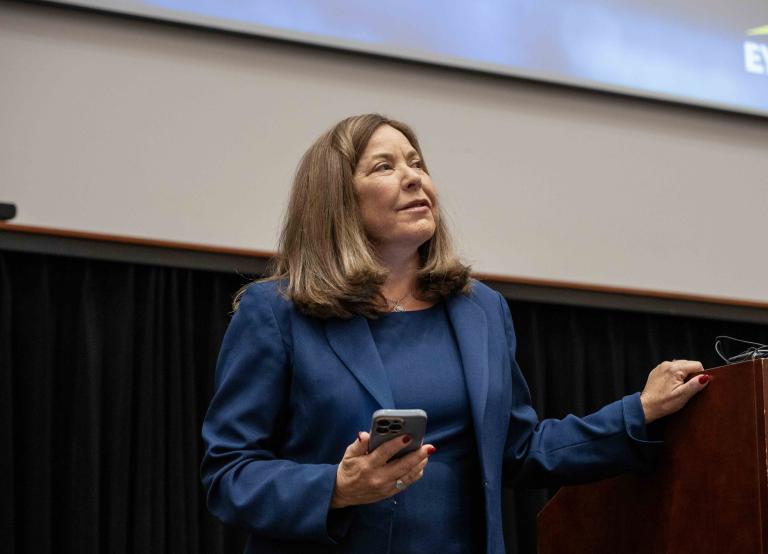
His daughter, Rhonda Orin Eisenstein, reflected on that legacy in closing remarks following Clark's presentation.
Eisenstein recalled the many speakers who have challenged students over the symposium's history, including whistleblowers, business leaders and individuals whose careers illustrated the consequences of unethical decisions.
Her father, she explained, understood the difference between learning ethical principles in a classroom and applying them when professional pressures make the right choice difficult.
Now, she said, a new generation will confront challenges her father could scarcely have imagined, including the rapid evolution of artificial intelligence.
Eisenstein encouraged students to approach those challenges with courage, integrity and a willingness to make difficult decisions.
"We're all counting on you," she told the audience.
For Clark, the responsibility begins with a simple principle: Professionals should never place their names — or their organizations' reputations — behind an AI-generated conclusion they cannot understand, support or defend.
As technology transforms the profession, he said, the future of accounting will ultimately depend not on what machines can accomplish, but on whether people can trust the information and decisions they help produce.