From Taco Bell to outer space: How one Trulaske professor is preparing students for the future of business
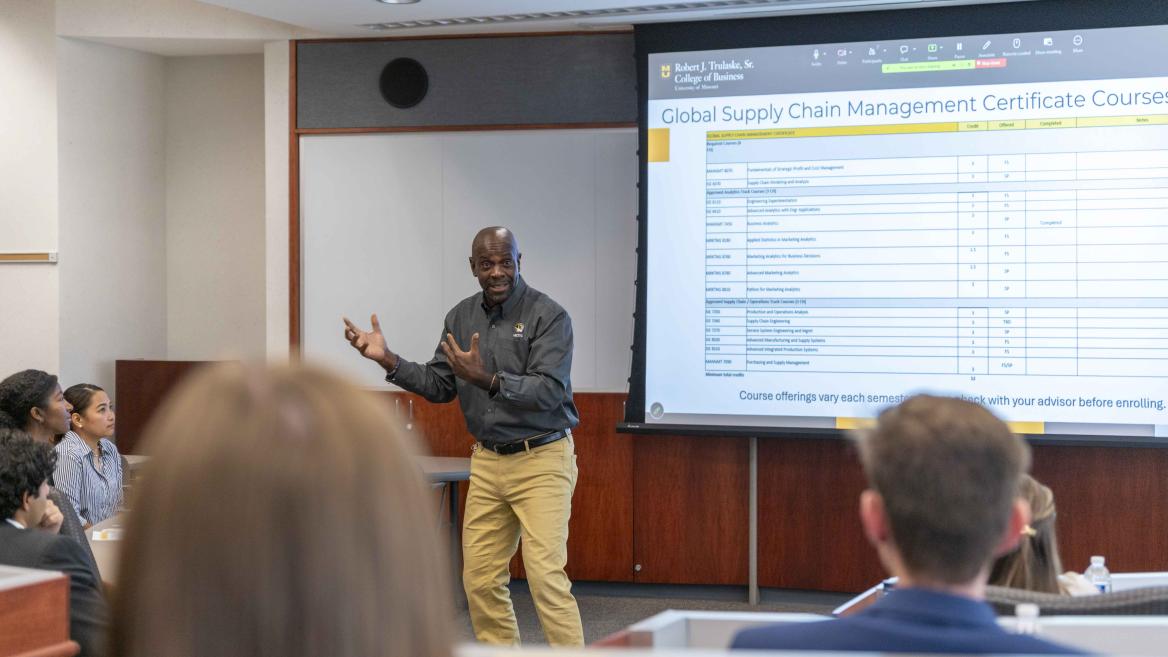
What do broken taco shells, returned Amazon packages and manufacturing in outer space have in common?
For Anthony Ross, they're all examples of how supply chains shape the world around us — and how dramatically that world is changing.
At the University of Missouri's Robert J. Trulaske, Sr. College of Business, Ross is helping students understand those changes and prepare for opportunities that may not even exist yet.
The Leggett & Platt Distinguished Professor brings an unusual combination of experience to the classroom. A former software engineer who worked in semiconductor manufacturing, Ross has spent decades researching supply chains, consulting with businesses and developing academic programs.
His expertise spans everything from logistics and inventory management to health care operations and supply chain design. But what distinguishes his approach to teaching is his determination to make the material relevant to the world students are entering.
That means using current business challenges to illustrate fundamental concepts — and encouraging students to think critically about the technologies and decisions that will shape their careers.
We sat down with Ross to talk about the future of supply chains, the role of artificial intelligence and what he hopes students take away from his classroom.
Most people became familiar with supply chains during the COVID-19 pandemic. What should they understand about how supply chains work?
Ross: Supply chains are about much more than trucks moving products or companies buying supplies.
Businesses have to anticipate demand, source materials, produce goods or services, deliver them to customers and manage what happens when products are returned.
And supply chains aren't limited to manufacturing. Hospitals, restaurants and beauty salons all have them.
COVID brought supply chains into everyday conversations because consumers experienced disruptions firsthand. Suddenly, people couldn't find toilet paper or paper towels, and they began asking why.
Today, one of the areas I'm particularly interested in is product returns. We're seeing enormous volumes of merchandise being returned, often to third-party businesses rather than the original manufacturers.
That creates questions about inventory, transportation, packaging and sustainability. What happens to all those products? How are they resold? And what are the environmental consequences?
Those are supply chain questions, too.
You use some unexpected examples in your classes, including Taco Bell and manufacturing in space. How do those help students understand business?
Ross: I want students to see how the concepts in their textbooks come to life.
Take Taco Bell. The company is constantly experimenting with new menu items, but developing a product is only part of the challenge.
How do you transport a fragile taco shell without breaking it? How long will the ingredients remain fresh? Can the product move efficiently through the company's distribution system?
Those are business decisions with supply chain implications.
Then we can look at something completely different, like Varda Space Industries, which is exploring manufacturing in space.
Certain products, including pharmaceuticals and other high-value materials, may benefit from manufacturing in microgravity.
Imagine a future where products are manufactured in space and transported back to Earth.
What would that supply chain look like? What kinds of jobs would it create? What information would businesses need to manage it?
We don't know all those answers yet.
That's precisely why I want students thinking about these possibilities now.
How do you keep your courses relevant when business and technology are changing so quickly?
Ross: One of the ways I do that is by bringing current business news and examples into the classroom.
I don't want students relying exclusively on cases that are 20, 40 or 50 years old.
Those cases can still teach important concepts, but students also need to understand what's happening right now.
Whether we're discussing product returns, food distribution, emerging technology or the challenges companies face in managing their workforces, I want students to recognize how supply chain decisions affect every part of a business.
Supply chains are constantly changing, and they span virtually every business function.
That's the perspective I want students to develop.
Artificial intelligence is transforming business. What role should it play in preparing students for the workforce?
Ross: I encourage students to use AI. It's going to be part of their professional lives.
But I also tell them not to rely on it.
Technology can process enormous amounts of data and generate recommendations, but people still need the ability to reason, evaluate information and make sound decisions.
I want students to use AI as a starting point for deeper thinking and deeper learning.
We're living through a period of technological change that reminds me of the transition from horse-drawn carriages to automobiles.
For a time, both existed together. Eventually, automobiles transformed transportation and the industries surrounding it.
I think we're experiencing a similarly significant transition today.
Technology is changing how we learn, teach, work and live. Students need to be comfortable exploring it while maintaining their ability to think independently.
Your own career began in software engineering. How did you find your way into supply chain management?
Ross: Quite honestly, by accident.
I'm a first-generation college graduate. While completing my computer science degree, I worked third shift on the production floor of a semiconductor manufacturing plant.
After graduating, I became a software engineer with the same company.
My work involved developing systems that allowed manufacturing equipment to communicate and share information, giving managers access to real-time production data.
Eventually, I realized that what I was doing was closely related to supply chain management.
We were connecting machines and facilities through networks so they could exchange information.
That's essentially what supply chains were becoming.
The field has evolved tremendously since then, but that experience gave me a practical foundation that continues to influence how I approach teaching and research.
Beyond supply chain knowledge, what do you hope students take away from your classes?
Ross: First, I want them to understand how supply chains can help a company succeed — or prevent it from succeeding.
But I also want them to recognize that learning doesn't end when they earn their degrees.
Over the course of their careers, our graduates are going to change jobs, move between industries and encounter technologies that don't exist today.
They'll need to develop new skills and adapt to new circumstances.
I believe universities like Mizzou have an important role to play in that process.
As a land-grant institution, we're here to serve our state and its people. If we maintain strong connections with our alumni and continue developing relevant programs, we can become a resource they return to throughout their professional lives.
That's part of what drives my passion for teaching.
I want students to finish what they start, but I also want them to remain curious and willing to learn for the rest of their lives.