Business, law and the questions AI is forcing us to ask
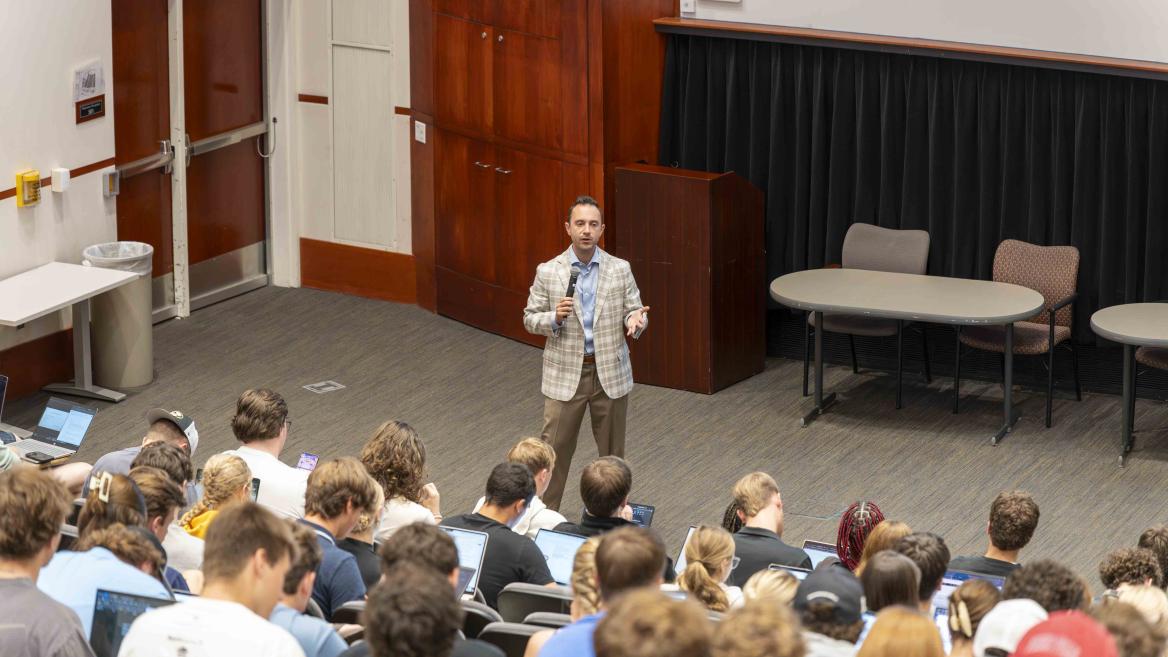
An assistant teaching professor at the Robert J. Trulaske, Sr. College of Business, Brand teaches business law while also teaching at the University of Missouri School of Law. Outside the classroom, he maintains an active legal practice through his law firm, George Brand Law, where he works with entrepreneurs, business owners and others on issues ranging from contracts and business transactions to litigation and dispute resolution.
That combination gives Brand a front-row seat to a business environment being reshaped by technology — and to new legal questions that come with it.
We caught up with Brand to talk about what every business student should understand about the law, the legal principles that make his students say, “Wait, what?” and why artificial intelligence may be making legal literacy more important than ever before.
What’s one thing every business student should understand about the law before they graduate?
One of the things I love about teaching business law is that, for many students, it’s the first law class they’ve ever taken — and for most of them, it will be the only one.
But the law affects everybody. You’ll get a job. You’ll negotiate a contract. You might buy property, start a business, create an estate plan or get a speeding ticket. You may never be involved in a lawsuit, but you’re going to encounter the law.
That gives me an opportunity to prepare students for something that will matter in their lives, even if they haven’t experienced it yet.
When people hear “lawyer,” they tend to picture lawsuits and courtrooms. Is that what business law actually looks like?
Not necessarily. A lot of law isn’t about disputes, arguments or trials. Sometimes lawyers are there specifically to help people and businesses avoid those things.
A lot of what I do in my practice right now, for example, is mergers and acquisitions — helping people buy and sell small businesses. Nobody is mad at anybody. It might be, “This person wants to buy my business. I want to sell my business. How do we do this legally?”
In the business world, lawyers aren’t always brought in because there’s a problem. Sometimes everyone is on the same page, and they just need help accomplishing what they’re trying to do.
We’ve seen some cautionary tales about lawyers using AI, from hallucinated cases to flawed legal filings. As a lawyer who uses AI, what does responsible use look like?
I use AI in my practice every day. AI programs can help lawyers work better, faster and smarter.
Some of the most visible examples of lawyers using AI have involved serious missteps, like submitting briefs with hallucinated cases. No judge is going to like that. But that’s only one side of the story.
AI can help people draft forms and answer questions that may not require a lawyer. It can help lawyers do their work more efficiently. There are pitfalls, absolutely, but there are also tremendous benefits.
The important question is how we use and develop these technologies responsibly.
Is there a legal principle you teach that consistently makes students say, “Wait, the government can do that?”
Eminent domain is a good one.
The Fifth Amendment’s Takings Clause allows the government to take privately owned property for public use — to build a road, school or fire station, for example — as long as the property owner receives just compensation.
That can really surprise students because it doesn’t necessarily match their conception of the United States as a country founded upon values of privacy, protection from government overreach and freedom.
I once had an international student from Germany in my class who simply could not believe it. He basically said, “I thought I knew a lot about the United States, and now you’re telling me the government can just take your privately owned land?”
Yes, it can. But only if the taking complies with the Fifth Amendment.
What legal questions will today’s students face that previous generations never had to consider?
AI is creating fascinating questions around intellectual property, ownership and liability.
Say I use AI to create a song and make money from it. Whose song is it? Mine? The AI company whose technology I used? Does it depend on how much direction I gave the AI during the song creation process?
Now flip it around. Suppose I use AI to draft a contract, the resulting contract is seriously flawed and something goes wrong because of those errors. Who would be responsible for the resulting damage? Me? The company that created the AI? A client who hired a lawyer knowing or expecting that AI might be used to assist in the drafting process?
These types of AI-related legal situations are already occurring, and these legal and ethical issues will only become more frequent and complicated as AI becomes more agentic and commonplace.
So, who does own the AI-generated song?
As I tell my students all the time, my opinion on that topic and, frankly, most legal topics I discuss in class, doesn’t matter. What matters is what judges, juries and lawmakers decide because they are the ones who can answer these questions in ways that create precedent and shape society.
Generally, courts have been reluctant to absolve humans entirely from questions of liability when things go wrong and someone tries to blame it on AI. Questions about who owns or can control new content, intellectual property or assets created by AI are more nuanced and murky and often hinge on the type and extent of AI used in the creation process. But as AI becomes more autonomous — and as more people start paying other companies to use their AI systems — we’re going to encounter increasingly difficult questions in these areas that government, and the judicial branch in particular, will be asked to answer.
For business students, that’s what makes this such an interesting time to study business law. The rules are evolving alongside the technology, and today’s students will build their careers in the world those decisions create. I’m grateful to have the opportunity to explore those questions with them.